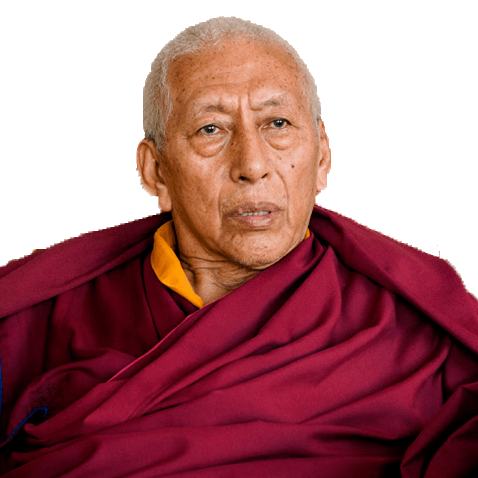
Prof. Samdhong Rinpoche was born in 1939 in Jol, in eastern Tibet. At the age of four, he was admitted in Yangchen Phuntsokling Monastery. At the age of five, he was recognised, according to Tibetan tradition, as the reincarnation of the 4th Samdhong Rinpoche and enthroned in Gaden Dechenling Monastery at Jol. Two years later he took vows as a monk, started his religious training at Drepung Monastery in Lhasa, at the age of 12 and studied upto Madhyamika class.
He fled to India in 1959, after the Tibet Rebellion, along with many Tibetans who followed His Holiness the 14th Dalai Lama, Tenzin Gyatso into exile. From October 1961, he served as the religious teacher of Tibetan School in Shimla and in 1963 served as the acting Principal. In 1964 he worked as religious teacher of Darjeeling Tibetan School and in 1965 at the age of 26, he was appointed as the Principal of Central School for Tibetans, Dalhousie and served there till 1970. He received his Lharampa degree in the year 1968 and Ngagrimpa degree in 1969.In 1971 he became Principal of Central Institute of Higher Tibetan Studies (CIHTS), Varanasi (Benares), and from 1988 to 2000 he was the Director.
From 1994 to 1995, he was awarded National Lectureship from Indian Council of Philosophical Research (ICPR), New Delhi. He assumed many important responsibilities including President of the Association of Indian Universities (AIU), a strong academic group of more than 250 Vice-Chancellors of Indian Universities, Chancellor of Sanchi University of Buddhist-Indic Studies and Chairman of various Trust and Foundations. He is regarded as one of the leading Tibetan scholars of Buddhism and is also an authority on the teachings of Mahatma Gandhi. He is fluent in Hindi and English, Tibetan being his mother tongue.
Rinpoche is one of the very few Buddhist scholars in the world with this depth, experience and clarity in Buddhist philosophy and he also spent many years exploring directly with J. Krishnamurti, who was one of the great educationists in India. Rinpoche has been an honored guest at many forums in India. He has spoken on challenges India faces today and has stressed on inclusion of the poor masses for development of the country.
In 1991 Rinpoche was appointed by His Holiness the Dalai Lama as a member of the Assembly of Tibetan People’s Deputies and later was unanimously elected as its Speaker. Rinpoche served twice as the Speaker of the Tibetan Parliament-in-Exile from 1991 to 2001. Rinpoche contributed to drafting the new constitution of the Tibetan Government in Exile, introduced economic and educational reforms, including the Basic Education Policy for Tibetans in Exile and ensured a policy of non-violence, transparency, environmentally sustainable, and organic farming.
In 2000 His Holiness the Dalai Lama decided that the Tibetan people in exile should elect their own Political Leader, and in July 2001, Rinpoche was elected as the first elected Kalön Tripa of the Central Tibetan Administration. Since 2001 he has travelled extensively to gain support for the cause of Tibet’s autonomy and raise awareness about His Holiness the Dalai Lama’s proposals for negotiating autonomy with the Chinese government.
During his Prime Ministership, Rinpoche negotiated many times with the Chinese officials to bring a suitable solution for Tibetan cause. However, no meaningful development could be made in this direction. Following the resignation of the Education Minister Mr. Thupten Lungrik on 29th May 2011, Rinpoche undertook the additional responsibility of the Health Kalön from 15th August 2006 to 25th May 2007.